This was our Annual General Meeting. Sixty two members attended; a good turnout on a cold, windy and wet evening! The Chair, Mrs Isabel hosted and committee members gave updates on finance, constitutional matters, and information about forthcoming trips and events. After the business was concluded, Isabel gave a round up of the past year's highlights before introducing the speaker.Mr Alan Gerrard is the chairman of Holehird Gardens in the Lake District, a garden run entirely by volunteers of the Lakeland Horticultural Society. His talk was about Herbaceous Borders.
Alan began his presentation by giving an overview of his life spent developing his skills as a gardener. His first garden was in Aberdeen ( from where his wife hails). Roses are famous in Aberdeen but Alan also noticed another attractive plant growing in his garden, so he carefully transplanted it. It turned out to be Rosebay Willow Herb (aka Wandering Willies)! A move to Milton Keynes provided the location for his next garden which included acers and climbing roses. The family then moved to Vienna for four years and although their home had no garden, the many beautiful formal gardens in Austria provided wonderful inspiration for any gardener. Three years living in Bangkok meant learning to nurture hanging orchids and tend Pomegranate trees! On returning to the U.K. Alan gardened on clay and flint in Northamptonshire for twelve years, honing his skills and knowledge and his love of gardening. As ever,
"A true gardener, like an artist, is never satisfied" H.E. Bates
Alan and his wife currently live in the Lyth Valley in Westmoreland. The valley has a tendency to flood from the nearby River Gilpin which flows on into the River Kent before entering the Morecambe Bay estuary. Alan and his wife have volunteered at Holehird Gardens near Windermere, for the last eight years, tending the East Bed which measures 30 x 6 metres - by 6 meters … a large walled herbaceous border.
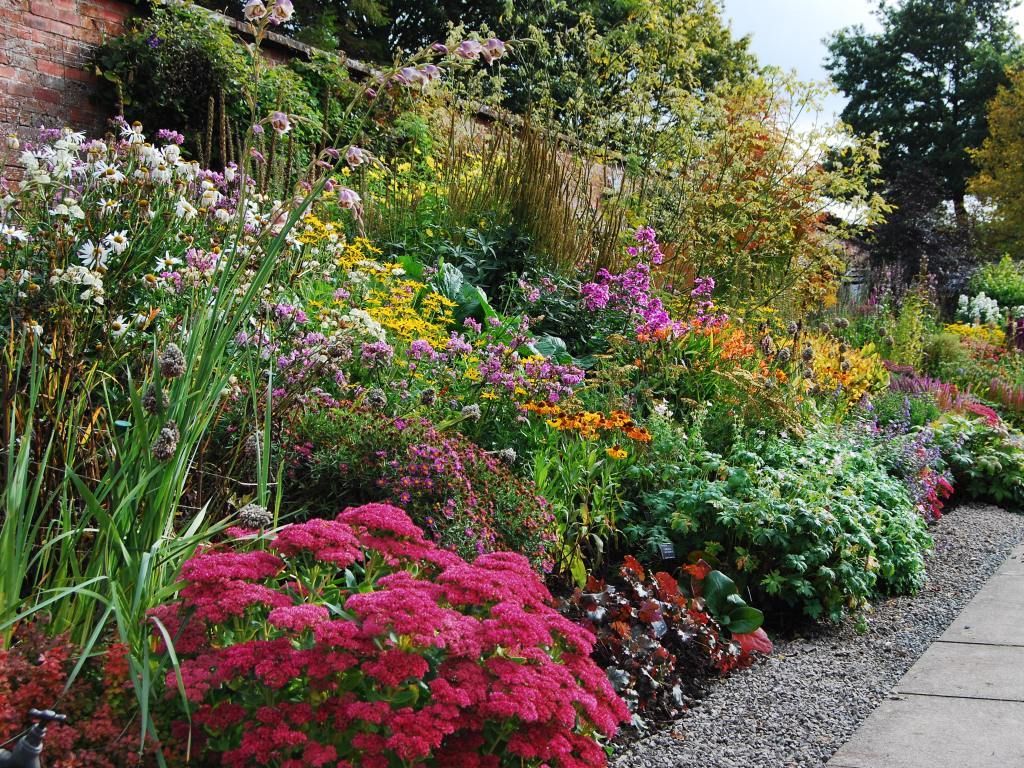
Alan spoke about what type of plants could be categorised as herbaceous, because many gardeners include a variety of different plants within a traditional herbaceous border. (They are Generally the term refers to any plants which do not develop woody stems.)
Gertrude Jekyll made this style very popular in the late 19th and early 20th century, using colour and drift planting. Christopher Lloyd copied this fashion at his home Great Dixter as did RHS Wisley and also Holker Hall in South Lakeland.

An initial task undertaken on the Holehird herbaceous border was to systematically remove all perennial weeds. This involved lifting out whole clumps of plants, washing the roots and removing every piece of root belonging to a weed before replacing the herbaceous plant back into the border. Ground elder, soapwort and even rosebay willow herb have been successfully eliminated by this method!!!Alan continued his talk by describing the task of making metal plant supports as well as weaving copious numbers of hazel frames in at least a dozen different styles. These are used throughout Holehird to support large plants. A copice in Arnside provides the raw materials. No matter how many plant labels are made and inserted beside a plant within the herbaceous border, they inevitably ‘disappear’. Visitors to the garden ask many questions and are always happy to offer free advice!
The Chair thanked Alan for his excellent presentation and for bringing a tray of plants which members could purchase.
Marilyn Lowe won the Lotto.
Members were asked to remember to bring cash or cheques to the April meeting if they wish to add their names to the Trip Lists. No seat can be allocated unless paid for in advance. Members take preference over non-members.
The Plant Sale is on May 30th. Members and Villagers are urged to start splitting and/or potting on plants or planting seeds etc., which can be sold at the Sale to boost Club funds.

No comments:
Post a Comment