Friday, 20 March 2026

12th March 2026 - AGM & Talk - 'Herbaceous Borders' by Alan Gerrard.

This was our Annual General Meeting. Sixty two members attended; a good turnout on a cold, windy and wet evening! The Chair, Mrs Isabel hosted and committee members gave updates on finance, constitutional matters, and information about forthcoming trips and events. After the business was concluded, Isabel gave a round up of the past year's highlights before introducing the speaker.Mr Alan Gerrard is the chairman of Holehird Gardens in the Lake District, a garden run entirely by volunteers of the Lakeland Horticultural Society. His talk was about Herbaceous Borders.

Alan began his presentation by giving an overview of his life spent developing his skills as a gardener. His first garden was in Aberdeen ( from where his wife hails). Roses are famous in Aberdeen but Alan also noticed another attractive plant growing in his garden, so he carefully transplanted it. It turned out to be Rosebay Willow Herb (aka Wandering Willies)! A move to Milton Keynes provided the location for his next garden which included acers and climbing roses. The family then moved to Vienna for four years and although their home had no garden, the many beautiful formal gardens in Austria provided wonderful inspiration for any gardener. Three years living in Bangkok meant learning to nurture hanging orchids and tend Pomegranate trees! On returning to the U.K. Alan gardened on clay and flint in Northamptonshire for twelve years, honing his skills and knowledge and his love of gardening. As ever,

"A true gardener, like an artist, is never satisfied" H.E. Bates

Alan and his wife currently live in the Lyth Valley in Westmoreland. The valley has a tendency to flood from the nearby River Gilpin which flows on into the River Kent before entering the Morecambe Bay estuary. Alan and his wife have volunteered at Holehird Gardens near Windermere, for the last eight years, tending the East Bed which measures 30 x 6 metres - by 6 meters … a large walled herbaceous border.

Visit - Holehird (en-GB)

Alan spoke about what type of plants could be categorised as herbaceous, because many gardeners include a variety of different plants within a traditional herbaceous border. (They are Generally the term refers to any plants which do not develop woody stems.)

Gertrude Jekyll made this style very popular in the late 19th and early 20th century, using colour and drift planting. Christopher Lloyd copied this fashion at his home Great Dixter as did RHS Wisley and also Holker Hall in South Lakeland. 

Gardens to visit in the Lake District | BBC Gardeners World Magazine

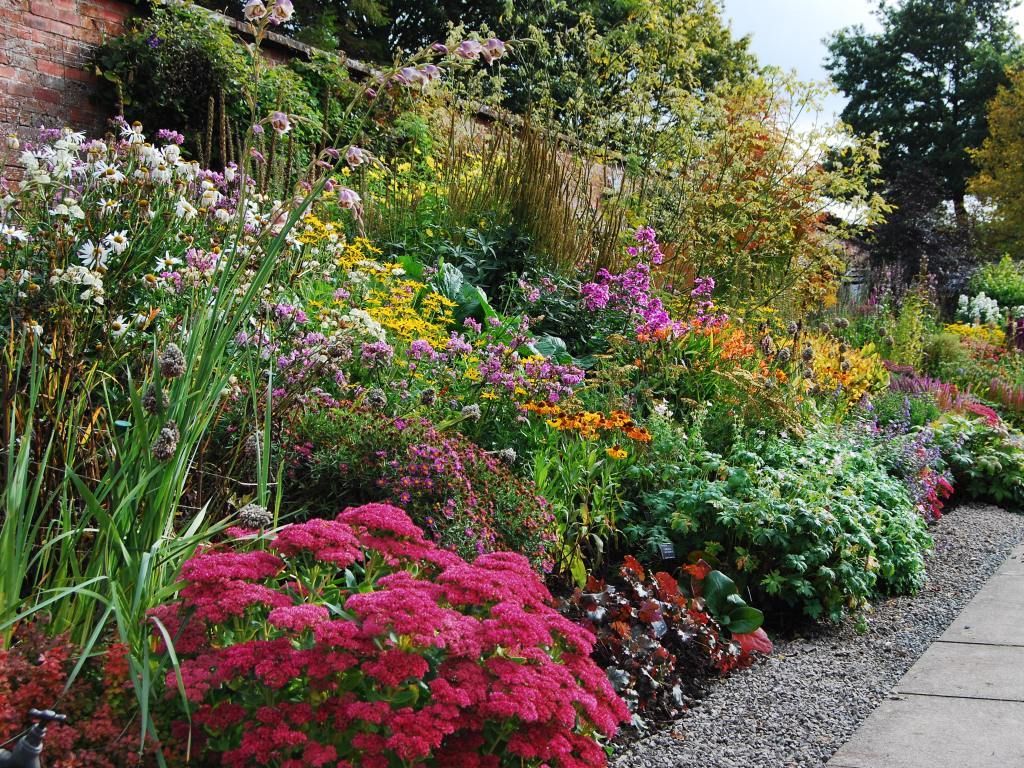
Height, width, scale, fragrance, leaf form, contrast and colour, together with personal preferences, are some of the aspects to consider when developing a herbaceous border. Questions from members bought Alan’s interesting talk to a close. One tip he gave was to spray roses in February with a diluted mix of Jeyes fluid to help prevent black spot. He advised to always make a record, take a note or photograph aspects of the garden throughout the seasons to use for future reference. 

An initial task undertaken on the Holehird herbaceous border was to systematically remove all perennial weeds. This involved lifting out whole clumps of plants, washing the roots and removing every piece of root belonging to a weed before replacing  the herbaceous plant back into the border. Ground elder, soapwort and even rosebay willow herb have been successfully eliminated by this method!!!Alan continued his talk by describing the task of making metal plant supports as well as weaving copious numbers of hazel frames in at least a dozen different styles. These are used throughout Holehird to support large plants. A copice in Arnside provides the raw materials.  No matter how many plant labels are made and inserted beside a plant within the herbaceous border, they inevitably ‘disappear’. Visitors to the garden ask many questions and are always happy to offer free advice!
The Chair thanked Alan for his excellent presentation and for bringing a tray of plants which members could purchase. 
Marilyn Lowe won the Lotto.
Members were asked to remember to bring cash or cheques to the April meeting if they wish to add their names to the Trip Lists. No seat can be allocated unless paid for in advance. Members take preference over non-members.

The Plant Sale is on May 30th. Members and Villagers are urged to start splitting and/or potting on plants or planting seeds etc., which can be sold at the Sale to boost Club funds.

Written by Jude Jansen
Visitors welcome for a small £3 fee

Monday, 2 March 2026

January & February 2026

The Viaduct Gardening Club met at Down-a-Gate Community Centre in January 2026, to celebrate the Festive Season  and welcome in the New Year…. With prettily decorated tables, the members enjoyed a buffet provided by Essen, a local company. Entertainment was led by our Chair, Mrs Isabel Ferguson, who had organised a plant-themed quiz together with a generous free raffle.
The February meeting welcomed Mrs Jeanie Jones, who gave an illustrated presentation all about her one-and-half acre garden of Kilnpotlees, Kettleholm near Lockerbie in the Borders.

She showed slides depicting a large range of plants which are in bloom from January to December in the garden she has designed and developed over the last fifty years.

A large variety of unusual specimens are grown by Jeanie from seed and she has travelled the world, meeting other specialist growers: swopping information and resources, all driven by a passion for propagation and a love of flowers and trees.
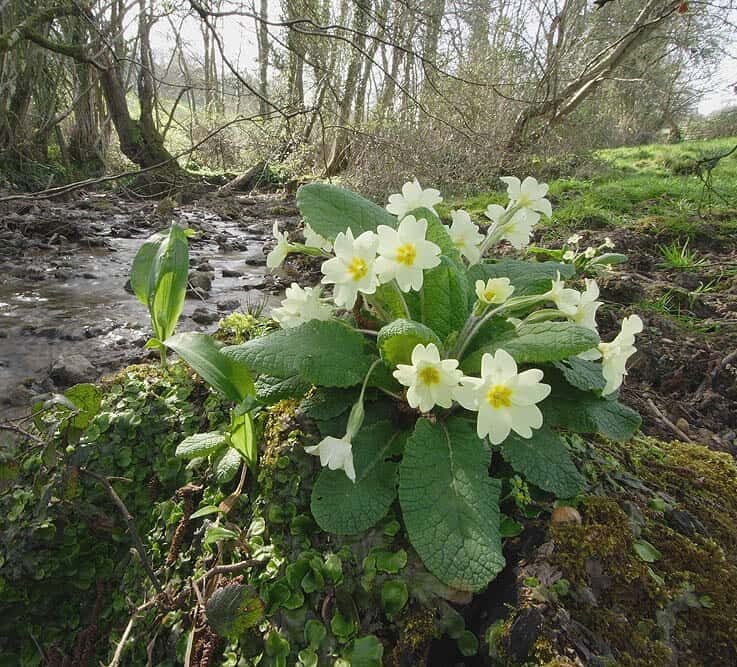
Primula vulgaris - Primrose - Emorsgate Seeds 


year begins, in her Borders location, by looking out for the first harbingers of spring ….winter aconites, of which she grows several unusual varieties, snowdrops and the beauty of silhouetted garden trees clothed in ivy.
February starts with Jeanie caring for her many varieties of meconopsis (which need to be fed and tended) and watching for emerging bluebells, iris, crocus and cyclamen, to name but a few.
By March, hellebores should have had their leaves removed in order to admire their floral beauty. Daffodils, primulas (in a vast array of form and colour), rhododendrons, azaleas, dog-tooth violets and other erythroniums, primroses all emerge into bloom. Around Jeanie’s large pond, marsh marigolds and an ancient variegated specimen of skunk cabbage, pulmonaria, and beautifully scented daphne are also in bloom, whilst being protected from the winds blowing across the Solway Estuary, by a large stand of ornamental bamboo .
April brings considerable work in Jeanie’s large propagation beds where precious seedlings, cuttings and grafts are nurtured.
Scattered around, self-seeded plants appear, (a sign that they are happy), to be enjoyed or transplanted.
In the woodland area of the garden there are trilliums, rhododendrons, Himalayan wild rhubarb among a carpet of bluebells.
Naturalised orchids, hostas, alliums and iris all herald in June. Clematis flourishes and ornamental trees such as elderflower add their own beauty.
Jeanie nurtures several varieties of Buddleia shrubs, loved by butterflies throughout July.
Nearby Threve Castle (NTS) has invited Jeanie to collect and propagate specimens of rare trees and shrubs on their property. An activity which she feels privileged to undertake.
The Summer season calls for greenhouse work, including a large productive grape vine which requires protection from invading wasps! Vegetables are rotated in the many kitchen beds to feed family and friends.
The garden blooms in August and September with outdoor grown eucomis and crabapples and rowan trees.
Cotinus Royal Purple Smoke Tree 
             As autumn approaches, mahonias and a Smoke Tree add interest and colour.
     Jeanie enjoys providing a home to several mallard families which have become residents on her beautiful pond. She also has evidence of visiting otters!
Overall, the presentation was an amazing annual overview of a garden nurtured and enjoyed by a knowledgeable and dedicated gardener…..a fifty-year long labour of love .
The Chair thanked Jeanie for her very interesting talk.
Mr Ian Forrest won the Lotto.
Next month’s meeting will be the AGM held on 12th March….The speaker will be Mr Alan Gerrard discussing Herbaceous Borders.
Visitors are always welcome for a small fee of £3.

Written by Jude Jansen

Friday, 5 September 2025

21st August 2025 - Raby Castle


A most enjoyable day - the weather was in our favour and the whole area picturesque.


The castle tour very informative with an overview about the history of the Nevilles and the Vanes.


Here we are, pictured in the servants dining room just before we went to the vinery for lunch. It was a lovely meal and gave us a chance to rest weary limbs before looking around the gardens.


These were a pure sensory delight: yew hedges, the iconic Raby fig mazes and amphitheatre. The cut flower gardens revealed roses, paeonies, dahlias, sweet peas and hydrangeas (to name but a few).


Afterwards we proceeded to Eggleston Hall Gardens; where we had a chance to buy more plants, look around the shop and gallery or just to relax in the cafe before heading home to reflect on another successful day away.

Written by Jo Watson with help from Lorraine


RHS, The Times & 'Mullet Gardening'...


https://www.rhs.org.uk/garden-inspiration/wildlife/mullet-gardening


Why ‘mullet gardening’ is the trend you need to try  Olivia Drake July 2025

Business at the front, (wildlife) party at the back. Is this a gardening style that’ll stick around for longer than the hairstyle?

Love them or hate them, mullets are back. But it’s an up-and-coming sustainable gardening trend, inspired by the famous cut, that we’re really excited about.

Meet mullet gardening: tidy at the front, wild at the back.

This approach to the management of borders, lawns and even entire gardens puts wildlife at the forefront while saving you effort – here’s how it works and why you should try it in your garden.

What is mullet gardening?

“It’s that idea of keeping things tidy at the front for presentation, while letting them grow a bit wild at the back,” explains Garden Manager Mark Tuson, a pioneer of mullet gardening at RHS Wisley. “It’s a way of gardening for wildlife, by providing habitat and food, while making it visually cared for.

“Hairstyles come in and out and the mullet has come back; the same happens in gardens. But gardening for wildlife is always key.”

Mullet gardening can be practiced in a variety of ways and at different scales – within a border, across a lawn, or even at the level of front versus back gardens.

It’s an ability to be mindful of how nature is integrated into our gardens

- Mark Tuson, Garden Manager, RHS Wisley
How to do mullet gardening in a border

A wide border is the perfect place to practice the graduated level of manicuredness that is central to mullet gardening: a neat edge, tidy front and dense planting can hide a real wildlife party zone behind.
Alex Paines, horticulturist at RHS Rosemoor, says: 

I blow leaves to the back of the bed rather than removing them all, to mulch & create habitat. Mulch is a layer of material, at least 5cm (2in) thick, applied to the soil surface in late autumn to late winter (Nov-Feb). It is used to provide frost protection, improve plant growth by adding nutrients or increasing organic matter content, reducing water loss from the soil, for decorative purposes and suppressing weeds. Examples include well-rotted garden compost and manure, chipped bark, gravel, grit and slate chippings. The soil has improved in the two years I’ve been doing this. I save prunings and trimmings to create brush piles for habitat in nearby but less visible areas.”

CHOP & DROP is a great technique to incorporate. When herbaceous perennials. Perennials are plants that live for multiple years. They come in all shapes and sizes and fill our gardens with colourful flowers and ornamental foliage. Many are hardy and can survive outdoors all year round, while less hardy types need protection over winter. The term herbaceous perennial is used to describe long-lived plants without a permanent woody structure (they die back to ground level each autumn), distinguishing them from trees, shrubs and sub-shrubs. When perennials are cut back, instead of removing and composting the trimmings, they’re simply cut up into small pieces and left in place, forming a layer that covers the soil around the plants and decomposes in situ.

Sarah Wilson-Frost, horticulturist at RHS Hyde Hall, was one of the first RHS horticulturists to adopt the technique, which is now widely practiced across most of the Gardens.

“At RHS Hyde Hall we use chop and drop for ornamental grasses and most herbaceous perennials,
” she says. ​“In the past we’d avoided leaving ‘hedgehogs’ of cut stems, cutting right back to the ground instead to keep it neat, but those short, upright hollow stems are actually really great for biodiversity, so we leave those too.”

So how do you chop and drop the mullet way? “If you leave the front two feet of the border as bare soil after cutting back, then chop and drop beyond, that makes it look intentional,”
says Sarah. “A neat edge gives the impression of neatness.”


How to mullet a lawn

Many of the grass areas in more informal areas of RHS Wisley, such as the Pinetum, are managed as meadows – something that can be easily emanated in a small garden by allowing grass to grow long. 

“We mow a strip around the outside to give an element of care, and then it’s wild beyond,
” says Mark. “This makes it feel well-presented and ensures it’s not flopping over pathways while encouraging different types of wildlife.

“Alongside long grass, shorter grass provides different opportunities for wildlife – short flowering plants such as clover for bees; worms accessible for birds.”

How to have a whole-garden mullet

You can apply the mullet gardening style at a whole-garden level – a tidier front garden facing the street, and a wilder back garden, where nature rules the roost.

“You can even apply the mullet concept to seasons, where the garden is wilder at the back end of the year,
” says Mark. “You can leave herbaceous stems standing tall over winter for solitary insects.

“I’ve done it a lot at home – last winter I left all my ornamental grass stems standing as dead stems. New ones have grown through so you can’t see the old ones. Nature works in yearly cycles, so I’m keen to see what effect that has a year later.

“Just because a stem is dead, that doesn’t mean it doesn’t have life in it. It might take a year to emerge, and when you cut it down early you lose that.

We can’t just be gardeners now. We have to think like ecologists too

- Sam Southgate, horticulturist at RHS Rosemoor
How to start mullet gardening at home

Mark has some advice for anyone keen to try this sustainable, wildlife-friendly approach at home – whatever size your garden.

“Figure out how you use your garden,” he says. “Is there a back of a bed where you don’t go where you can put a pile of sticks or let plants grow that you might consider weeds elsewhere? You can do it on any scale."

“Sometimes being a tidy gardener isn’t beneficial for others using your garden. Allowing a bit to go more wild will benefit other wildlife in your garden, starting with insects, which will then fuel all the other life that follows.”


Providing for wildlife, enriching your soil and reducing effort for the gardener, this approach could just be the all-round win we all need in our gardens.

Time to embrace your inner mullet / or not???


Tuesday, 24 June 2025

19th June 2025 - Annual Charity Evening Garden Visit

Just after the summer solstice our annual ‘Charity Evening Garden Visit’ was held at Ruth & Mike  Couzens’s grade II listed home, Crosby Lodge at Crosby-on-Eden.


Historic England describes Crosby Lodge as:

c.1807-10, possibly by Peter Nicholson and William

Reid, for David Kennedy of Carlisle, with mid-C19

and C20 additions. English garden wall bond

brickwork, tower of coursed red sandstone rubble

walls, stone dressings, roof hidden by parapets.”


The June weather was truly glorious - a ‘flaming’ June evening.


The expression “Flaming June” is beloved by headline writers, implying that the month traditionally brings tropical warmth. However, the phrase is not directly connected with the weather.

Flaming June is the title of Sir Frederic Leighton's 1895 painting of  a woman in an orange dress sleeping under a canopy in the summer heat. 

Leighton was thoroughly ambiguous: the woman has flame-red hair, and it is unclear whether June is her name, or if the scene takes place during June, or whether she is the personification of the month.

The Guardian


Saturday, 31 May 2025

31st May 2025 - Annual Plant Sale at Wetheral Community Hall


All of us on the Committee were delighted with the support given by so many, to make our Annual Plant Sale such a success today.


Thank you so much to those who helped us set up last night and for those stepping in today to be on the stalls, teas, door, sales and raffle. A fantastic effort by all and a great public response. 

Thank you to everyone who brought along plants and all those delicious cakes, and, to everyone who came along and supported the event.


We raised over £1900!
Expenses have yet to be deducted  but we will keep you informed and the amount to be donated  to The Eden Valley Hospice.


Dates for your diaries.
Members Martin and Ian at Ivy House , Cumwhitton, CA8 9EX have their lovely garden open for the NGS on the 22nd, June and 10th, August (1-5pm). So hope members can support.
Brampton East  Gardens , Brampton CA8 1EX are open 6th, July between 1-5.00pm. Details on NGS site.

Again a very big thank you to everyone for making today such a success.

Liz Webster
VGC Secretary.


Tuesday, 27 May 2025

15th May 2025 - Day Trip to Gardens of the North East, near Morpeth

The Lake at Bichfield Tower, Morpeth

Fantastic weather, two gorgeous gardens & a wonderful nursery – a huge thank you to Sandy, our new trip organiser.

1. First up was STANTON FENCE - home to Sir David Kelly and his late wife, Angela.

This has been the Kelly home since 1969. Firstly a farm with land to enjoy the world of horses, the gardens were designed in early 2000s by Arabella Lennox-Boyd. For twenty two years Steve Grimwood has been the head gardener.

Stanton House was featured in Country Life in 2018 – so do have read & enjoy the pictures of mid summer, by Val Corbett.

https://www.countrylife.co.uk/gardens/stanton-fence-traditional-english-garden-transformed-touch-chelsea-gold-medallist-182425

Morning coffee & tray bakes were much appreciated.


Lady Kelly was a keen grower of indoor pelagoniums. For some these plants belong to the 1970s, perhaps appealing more to the a senior population.

However seeing them grow en masse - in gutsy profusion of health and colour - they were stunning!


2. Lunch was at STANTON HALL GARDENS & NURSERY.

The nursery is a small family run business, offering something different from the larger garden centres. This five star Trip Advisor rated nursery is a wonderful resource.

    “Forty years ago, the nursery was started as a market garden growing and selling soft fruit,             vegetables and cut flowers. As the days of ‘freeze your own’ declined, we progressed into                 annual summer bedding plants then into perennials, shrubs and trees. We still grew vegetables         but now as plants to sell. This was still as part time as we both had full time jobs elsewhere.

    Since we became self employed we have focused on plants and not followed the big garden             centres into franchising areas out. We felt that this way we keep a “garden” atmosphere. We are     only open for half the year during the growing season April-mid September, as we find there are     few winter gardeners! We aim to provide good quality plants, reasonably priced, with advice on     all areas of cultivation.    

    The gardens have developed over the years as trade increased, with Chris’ imaginative                     constructions mostly from re-cycled materials, enhancing the planting. Claire uses the gardens         as an important source of seeds and cuttings to produce the new stock each year. We hope we         have created a garden which people are happy to visit and enjoy."

https://www.stantonhall.co.uk


The Roof of Bichfield Tower's GinGan

 Lunch was taken in the GIN GAN

For some of us this was a new name. 

A gin gang is a wheelhouse (often horse powered) which is usually circular and attached to a threshing barn. Most were built in England in the late 18th and early 19th centuries.

The gin was short for "engine" and the gan for “going”.


3. Our final destination was to BICHFIELD TOWER, Morpeth. This beautiful mediveal, pele tower is the home of Lesley and Stewart Manners. Set in approximately six acres: there is an impressive stone water feature, large trout lake, mature woodland, pear orchard, and two walled gardens. Extensive herbaceous borders, prairie borders and contemporary grass borders live harmoniously together.

Afternoon refreshments - Thank you Lesley

Wisteria adorned walls

Bichfield Tower is open for the NGS on 13th July 2025
A date for your diary perhaps.


Written by Trish Rodgers


.