Apologies to all those, who aren't Times readers. Send me some of your favourite articles for the blog.

After a few indulgent and busy months, January is a good time for gardeners to reflect on what they achieved last year and what this one may hold. It probably sounds like a to-do list is being formulated (and there may be a useful one later) but this piece is about the opposite: how to work and worry less in a bid to enjoy your outdoor space more. So grab a cup of tea and sit on a comfy chair, somewhere it’s warm enough and you have a good view of the garden.
Some gardeners are only content when they’re actively getting on with it but most of us don’t want to see the garden solely as a place where there’s always work to do. A garden is supposed to be a sanctuary too: somewhere to switch off, be in the moment, connect with the natural world and be thankful for what we have.
If your garden stresses you out, this thought may help. It will be under your tenure for about a gnats’ breath of the time that planet Earth has existed and will exist in the future. For the billions of years before it was your garden, and I’m guessing the billions after, it simply was or will be a piece of land at times inhabited by the natural flora and fauna that made and will make a home there. You are a part of that fauna curating the flora. You may now feel a little insignificant but I hope you are also somewhat released from any associated stress and commitment. Gardening should be fun, you can only do what you can, and the true garden workaholics among you may not like this but for you and your garden sometimes the best thing to do is … absolutely nothing.
This leads us on to wildlife, biodiversity and weeds. Your garden may already be a fabulous habitat and resource. Animals prefer a wilder environment and often benefit from a more relaxed, “do less” approach (such as not cutting back perennials until spring, leaving some grass unmown and leaving fallen leaves on beds). This means less work for you and in turn it will increase the range of critters and their predators too, to make your garden feel truly alive. Many weeds have thankfully been rebranded as “wildflowers”, so in areas where they don’t take over and smother the ornamentals, if you’re struggling, they can be left as part of a mini rewilding exercise. That’s what you can tell your old-fashioned friends anyway, the ones who expect to see stripes on the lawn. I’ve said before that rewilding a back garden is impossible but making it more wildlife-friendly is easy.
So part of this approach is down to philosophy and some engagement. The engagement element is all part of the master plan and, yes, will require some thought and even effort — but not today. Here are a few tips:
Some garden furniture has been designed like that in fast-food restaurants to discourage settling. Perhaps invest in some super-comfy garden furniture, complete with cushions, on which to lounge, read a book or take an afternoon nap. Other “leisure” items for outdoor living such as firepits, solar lights and barbecues are all encouraged too.
Some gardens just don’t have enough spots to sit down in, which means you walk round in circles spotting the never-ending tasks that need doing. A simple bench placed under a tree in a shady spot for summer, and perhaps another in the sunniest spot halfway down a path to catch a few rays, will do the trick without turning your garden into a park. They can also be used to perch on during the physical act of gardening, to slow you down a bit and serve as a spot from which to admire your handiwork.
Whether they flap, flutter, buzz or crawl, animals animate the garden and make it feel alive. I’ll be putting up some bird and bat boxes soon, along with upping the number of bird feeders. I’ll also be putting in a shallow reflective pool (to reflect the passing clouds — another element to zone out to) that will double up as a bird bath. Watching birds come and go brings me great pleasure and costs next to nothing. I can sit and watch them for hours; in fact, as I write this there is a mini-flock of goldfinches on my feeder, wonderfully exotic-looking creatures. Plant nectar-rich plants with bees and butterflies in mind — again, they are part of the show as well as needing our support.
Not everyone has a view on to their own garden but if you do, consider how a window best frames it. Moving an indoor chair or sofa just a little may make all the difference to what you see outdoors. You can then focus in on that composition by placing an ornament in view or bumping up the planting. We have recently had a refurb in some rooms and many decisions were based on the connection with the garden from inside in a bid to enjoy it year-round. We lowered a big window in the living room by about 40cm and I can now look on to the garden from the comfort of the sofa. We also replaced an ancient exterior solid door with a full-length glass one, to open a view and watch the birds. This all encourages engagement and enjoyment, and is a result of sitting and thinking it all through before doing anything.
Gardeners can get absorbed in the minutiae of the process, are always looking forward and are often humble folk who don’t like to pat themselves on the back. Looking at images of when you took the garden over, a key project or perhaps a border when it was first planted will remind you just how far you’ve come. It will help to define what your garden means to you and all the positive things you’ve done for your piece of planet Earth ‒ even if it is only for a gnat’s breath.
Added by Trish Rodgers

A fun packed New Year party always brings some competion! Are you in these photos?


https://www.countrylife.co.uk/gardens/warnell-hall-cumbria-sympathy-experimentation-go-hand-hand-176538
The illustrated talk Lyn gave was all about the defence strategies evolved by many plants in order to protect themselves against hazards caused by animals and insects which threaten their survival in a ‘hostile’ environment.
Lyn began by explaining how plants protect themselves in many different ways such as by stinging, poisoning and emitting saps which cause skin irritation. This armoury includes thorns, prickles, and spines. Razor sharp leaves, leaves which sting and leaves which emit poisonous spores, including too, those which have toxic hairs and produce indigestible fruit.
Common plants which use thorns as protection include roses, thistles, holly, monkey puzzle trees, gooseberries and most cacti. Others which exude an irritating sap are all euphorbia, henbane, hogweed, hyacinth bulbs, rue and fig stems.
Nettles are our only indigenous stinging plant. The tiny needles on the leaves contain histamine acids which cause painful skin blisters. Hairy vegetation found on plants such as comfrey, both leaves and stems, goose grass, cucumbers, courgettes and phlomis, to name just a few, can cause skin to be adversely affected.
Also unpleasant to many people are the spores of some plants, especially bracken, and also ivy which should only be cut down when damp in order to suppress the spores escaping into the air and causing breathing difficulties.
Many bulbs are poisonous. Bluebells, daffodils, narcissus, and tulips must never be eaten.
Edible plants can also have defence mechanisms. Chilli plants and capsicum can be hugely irritating when ingested! Whilst rhubarb stems are edible, the leaves should never be eaten.

Florists and everyday gardeners must take protective action by wearing gloves when regularly handling such plants as alstroemeria, aconites, asparagus foliage, euphorbia and hellebores.
Some berries and flowers are very toxic when consumed and although they might be attractive to look at, they must never be consumed. Arum berries, daphne, deadly nightshade, foxgloves flowers, laburnum and nicotiana are some of the well known culprits but there can be nasty side effects from consuming other common vegetation.
Many pharmaceuticals now mimic the properties within plants to make drugs. Yew used to be collected from the wild to make certain drugs (but now can be chemically produced). Poppies (opium) also provide many familiar commercial drugs.
Lyn described frequent personal incidents when either she or colleagues had unfortunate experiences and reactions whilst working in their plant filled environments!
Written by Jude Jansen

Thank You for Coming
Can you find yourself in these pictures?


 |
| Anne - our retired chairman |


Why not come an join our club?
We enjoy sharing garden knowledge and activities; whether we are beginner or experienced gardeners.

Doug began his talk by describing some new, scientifically engineered methods of killing off weeds from food crops which do not involve widespread use of chemicals and insecticides. Using heat to ‘cook’ and sterilise weed seeds, (using robotic cameras equipped with hot ‘guns’ and Laser technology) are being actively trialled. There is even a scheme to ‘farm’ spiders which will eat certain flies!
The RHS ‘New World’ Vegetable Garden at Wisley is at the forefront of such experimental methods: seeking to dispense with toxic products in favour of (often ‘age old’ methods) to control of weeds.
As an advisor and lecturer to the RHS, as well as many other horticultural training institutions, Doug is passionate about how gardening can be sustainable yet also very productive.
Doug talked about using a ‘no dig’ style of growing vegetables and the benefits of using home-made compost. He also suggested dividing small plots into grids (with companion planting) for rotational vegetable growing - the 'Patchwork' Approach'! In itself, crop rotation helps to keep the chemicals in the soil in better balance, improving prevention against infection. Rain water too helps healthy growth. So rain water needs to be captured but also used (not becoming stagnant).
Doug warned us about the need to research what veterinary medications might have been administered to any cattle/horses before using their dung to enrich our garden soil . Also what sprays / weed killers might have been used on the straw bedding of such animals (as this bedding is inevitably mixed in with manure). Antibiotics and worming treatments can have a negative impact on food production.
There were reminders during the talk about making full use of plastic products; not discarding them when they can be re-used in many innovative ways. Plastic as a product is very useful. Take care that wooden raised beeds may be harbingers for slugs & snails!
In summary, Doug reminded us to be 'mindful' of how we nurture our productive vegetable gardens. And of course whilst doing so we must take breaks for our wel being,

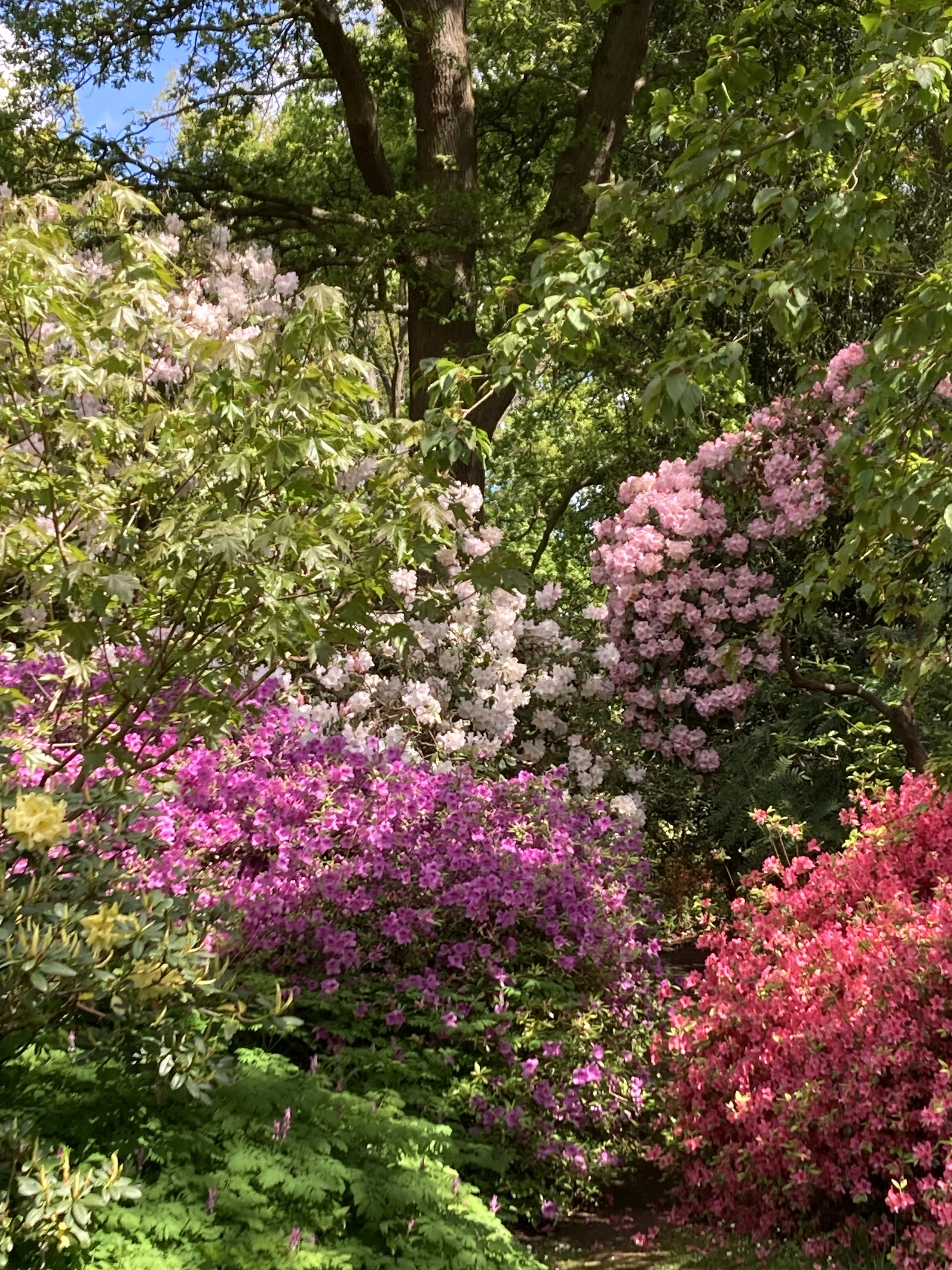
Do send us pictures / notes from any garden visits you make.... Here are some from Jude's recent mid spring visit to Windsor Great Park