Thursday, 23 May 2024

9th May 2024 - Grow Your Own


Doug began his talk by describing some new, scientifically engineered methods of killing off weeds from food crops which do not involve widespread use of chemicals and insecticides. Using heat to ‘cook’ and sterilise weed seeds, (using robotic cameras equipped with hot ‘guns’ and Laser technology) are being actively trialled. There is even a scheme to ‘farm’ spiders which will eat certain flies! 

The RHS ‘New World’ Vegetable Garden at Wisley is at the forefront of such experimental methods: seeking to dispense with toxic products in favour of (often ‘age old’ methods) to control of weeds.

As an advisor and lecturer to the RHS, as well as many other horticultural training institutions, Doug is passionate about how gardening can be sustainable yet also very productive. 

Doug talked about using a ‘no dig’ style of growing vegetables and the benefits of using home-made compost. He also suggested dividing small plots into grids (with companion planting) for rotational vegetable growing - the 'Patchwork' Approach'! In itself, crop rotation helps to keep the chemicals in the soil in better balance, improving prevention against infection. Rain water too helps healthy growth. So rain water needs to be captured but also used (not becoming stagnant).

Doug warned us about the need to research what veterinary medications might have been administered to any cattle/horses before using their dung to enrich our garden soil . Also what sprays / weed killers might have been used on the straw bedding of such animals (as this bedding is inevitably mixed in with manure). Antibiotics and worming treatments can have a negative impact on food production.

There were reminders during the talk about making full use of plastic products; not discarding them when they can be re-used in many innovative  ways. Plastic as a product is very useful. Take care that wooden raised beeds may be harbingers for slugs & snails!

In summary, Doug reminded us to be 'mindful' of how we nurture our productive vegetable gardens. And of course whilst doing so we must take breaks for our wel being, 

"... stopping often and listening to the birdsong."

Written by Jude Jansen

May 2024 - Inside & Outside at Windsor Great Park

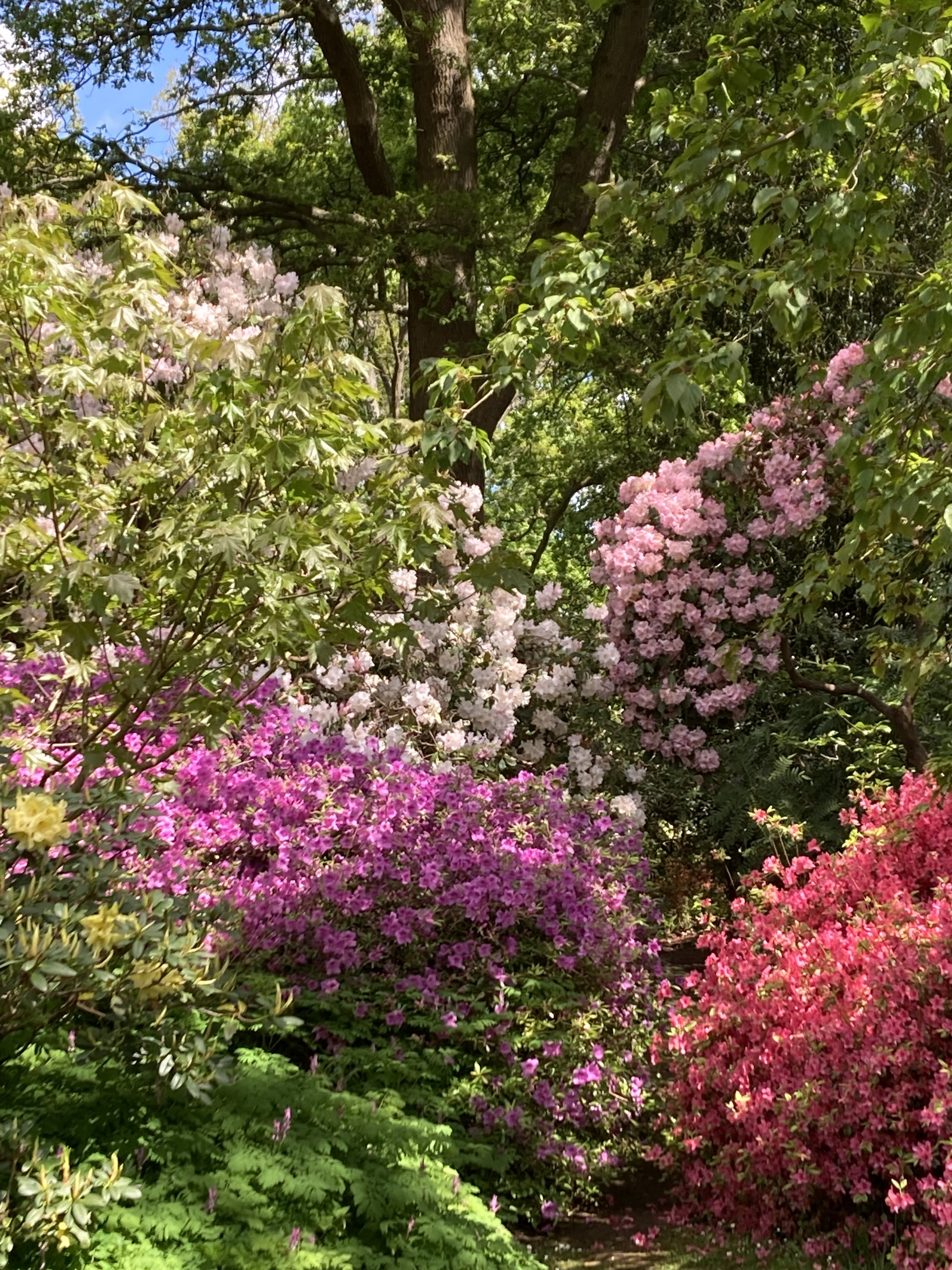
Do send us pictures / notes from any garden visits you make.... Here are some from Jude's recent mid spring visit to Windsor Great Park

https://www.windsorgreatpark.co.uk


Tuesday, 14 May 2024

11th April 2024 - Herbs and Flowers for Hanging Baskets - Helen' Herbs


Helen and her family have lived near Cleator Moor on the fringe of the Lake District for some fifteen years. Following a teaching career, about eight years ago she decided to concentrate on cooking and growing plants and herbs on their one and a half acre property, within three poly tunnels.

After showing us a wonderful display of plants and herbs, Helen began her presentation with a demonstration of planting up a hanging basket using ‘pollinator’ plants. The basket was plastic-lined before being filled with multi-purpose compost and slow release fertiliser. She then planted a variety of flowers for all year round interest: ajuga for spring / summer flowers - aubretia, wallflowers and a nepeta which can flower over the winter, along with veronica which is beloved by bees.

Next Helen planted up a moss-lined hanging basket with summer annuals. She again recommended using slow release fertiliser for plants in pots and containers. Helen also uses an initial feed of phosphate when planting, followed by a twice-weekly seaweed feed until flowering begins. A regular tomato feed maintains sufficient nutrients. Helen chose nemesias – varieties Little Cocoa and Pink Lemonade, followed by diascia Apple Blossom , a saffina and a trailing nepeta.


Helen's husband ( a retired teacher) makes troughs and containers to order and Helen set about planting up one of his wooden troughs using just herbs. Layering compost with grit prevents the herbs from becoming waterlogged. French parsley, rosemary, marjoram, sage and a thyme were added. Regular trimming and cropping the herbs for culinary use, prevents any of them becoming too vigorous.

Helen then described the many varieties of herbs which they grow on their property and had brought samples for us to see. Planting a pollinator friendly herb container using chives, thyme, hyssop, sage and lavender is an easy way to support insect life.

Historically, herbs and flowers have been given symbolic meanings and Helen pointed out a few -


Myrtle - for everlasting love (used in Royal wedding bouquets)

Tarragon - is symbolic of enduring love

Basil - means good wishes and purity,

Chamomile - to indicate patience.


Many herbs also have beneficial medicinal uses. In medieval times lemon balm was used to relieve anxiety and teas using garlic and ginger were brewed to fend off colds and infections.

Finally, members had an opportunity to purchase some of the plants and herbs they had brought with them.

Helen's Herbs can be found around Cumbria

at various Farmers Markets, Food fairs and Shows.

www.helensherbs.co.uk


by Jude Jansen

Wednesday, 27 March 2024


PICTURE PERFECT PLANTS - £65 Course

Locations: 

Holehird Gardens, Patterdale Road, Windermere LA23 1NP
Thursday, 29th April 2024 &  Saturday, 14th Sept. 2024 
& 
Lowther Castle & Gardens, near Penrith, CA10 2HH
Thursday, 10th June 2024

Time: 1 day course, 10.30am-3.30pm 

https://www.nrtraining.co.uk/find-a-course/p/pictureperfectplants

or contact via mobile - 07940 151563


DESIGNING WITH PLANTS - £400 Course

Locations: 

Holehird Gardens, Patterdale Road, Windermere LA23 1NP
& 
Lowther Castle & Gardens, near Penrith, CA10 2HH

Time: 4 days over 4 months (see website), 10.30am-4.oopm with two start dates (Autumn/Winter and Spring/Summer courses)  

https://www.nrtraining.co.uk/find-a-course/p/garden-design-24wks-october-2021-start-azgb2

or contact via mobile - 07940 151563  


8th February 2024 - Preparing the Garden for Summer - Pinetree Nursery, Glassonby

Lyn and Duncan Wilson from Pine Tree Nursery, gave an interesting presentation entitled ’Preparing for Summer’ , illustrated by a series of slides.

The first part of Lyn Wilson’s talk was centred on the fact that many insects and birds are dependent for winter food on the seed heads of many of our garden plants. 

Her advice was to, not cut down and clear away every autumn plant but to leave those with seed heads to overwinter as sustenance and shelter for wildlife. 

One of the slides showed goldfinches feeding on seed heads in her garden. The protective warmth offered during their hibernation period is vital for ladybirds and lacewings, both of which are voracious aphid eaters. Once the outside temperature rises to 10 degrees, bumble bees tend to appear and so early flowering plants provide invaluable nectar for them. Bug, butterfly and bee boxes in the garden are an excellent way to encourage more wildlife into your garden.


Plants to consider for early spring sustenance to small creatures include mahonia, sarcococca , jasmines, helebores, snowdrops and primulas.

The second part of the talk was a very useful practical demonstration of how best to prune a variety of shrubs and plants in order to maximise their flowering potential. Plants from Pine Tree Nurseries were used as demonstrations to indicate how, why, where and when to prune. 

Sharp cutting tools are essential and the basic 3 D’s (dead, diseased or damaged) provide a rough guide when deciding which branches are removed including any which are crossing or rubbing or are weak and straggly.

A Quick Synopsis for Pruning:

Group 1 - The first group of plants to prune are those which flower in summer and bloom on the same season’s growth….buddleia, spirea, hardy fuchsia, perovskia, hydrangea and roses.

Group 2 - The second group are those which flower on the previous years growth and flower during the winter months and spring, such as philadelphus, weigela, ribes, forsythia, vibernam.                 These are all pruned after flowering.

Group 3 - Thirdly, evergreen shrubs are best trimmed after all risk of frost has past to avoid any damage and dieback caused by frost penetrating freshly cut stems.

Another common principal of pruning is to only remove about one third of the stems of a plant each year in order to maintain a good structure and encourage more blooms.

In Cumbria ... "advice is to delay all pruning due to our northerly colder climate."

Lyn then demonstrated how to prune the various types of hydrangeas…including paniculata , arborescens and macrophilla. Other plants used to demonstrate care and maintenance tips included lavender, dogwoods, herbaceous  perennials, sedums, hemerocallis( day lilies), iris sibirica, and various ornamental grasses.

A fact-filled, practical and informative evening’s entertainment was followed by the opportunity for members to purchase plants from the wide selection available which had been brought from Pine Tree Nurseries.

https://pinetreenurseries.co.uk


by Jude Jansen

11th January 2024 - New Year Party


On 11th January at Down-a-Gate Community Centre, we together to celebrate both the Christmas Season and to welcome in the New Year.

The committee had prepared the hall for over 50 members to enjoy a very well received buffet including a varied and tasty array of food, provided by ‘The Posting Pot’ in Wetheral. Wine and soft drinks were also served.


When everyone had finished their meal our Vice -Chair, Mrs Isabel Ferguson, hosted two games of Bingo. Everyone took part and the game proved an enjoyable interlude.


Thursday, 5 October 2023

Ferns - Steven Moss - September 14th 2023

A talk by Mr Steven Moss, a volunteer gardener from Holehird Gardens near Windermere (which is a member of the Lakeland Horticultural Society).


Holehird is a ten-acre fellside garden which was founded in 1969 and has no permanent staff, being run entirely by volunteers. The garden is open from dawn until dusk and visitors can purchase a variety of plants which are on sale and enjoy a drink on the premises. Holehird also holds six National Collections ….Astilbes, Daboecia (a type of heather), Mouse Ear miniature hostas, Meconopsis and Tanacetum (painted daisies). They also grow  a large collection of ferns because on the whole, Cumbria has ideal weather conditions for successful fern growing. 


The British Pteridological Society was formed in Kendal in 1891 and is still active in the area searching and cataloguing specimens of local ferns. The Victorians were keen fern growers and did a lot of hybridisation and collecting of ferns.


As a species, they thrive in a wide range of habitats, shady, dry, damp, and can tolerate  acid or alkaline soils, and make a perfect foil for other plants. (There are 400 million year old fossils which depict ferns)
The Holehird fern collection was started in 1987 and has over 100 plants and 18 species including 26 different varieties.

Mr Moss showed slides to illustrate his informative and often humorous presentation and explained how best to make a ‘loggery’ which provides a perfect growing area for ferns and he gave tips on the best methods of nurturing these plants.


He also showed how to propagate ferns by collecting spores from the nodules on the underside of fronds, and continuing a fairly lengthy process of sterilising soil, avoiding contamination from the air, and which hopefully results in tiny green fern growth many months later! An easier way to propagate is to split the rysomes (crowns) or to grow on by layering the tiny bulbuls which often form along the fronds of some ferns.

Written by Jude Jansen